What is
DORA?
DORA Regulations
So, complying with DORA is a significant challenge for compliance teams. The EU regulation requires financial institutions to strengthen the resilience of their ICT systems and rigorously manage risks arising from reliance on third-party technology and service providers. Failure to comply by January 2025 can result in fines of up to 1% of average daily turnover, before factoring in the broader operational, reputational, and regulatory consequences that sit beneath the surface.
Scope of DORA
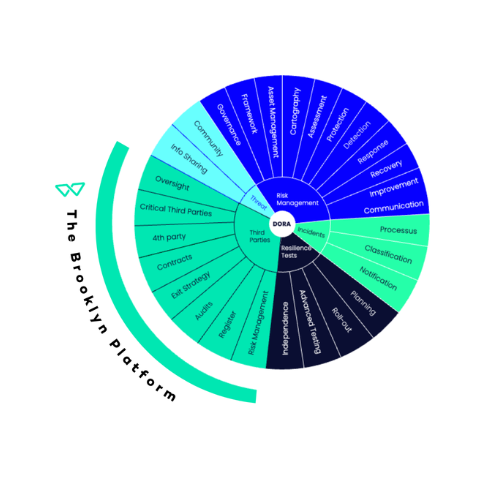
Consequently understanding the cope is key: DORA builds on existing industry guidelines to establish clear, consistent requirements for ICT risk management, operational resilience testing, and third-party risk oversight, ensuring the uninterrupted delivery of financial services across the entire value chain. The regulation mandates that all in-scope financial entities achieve full compliance ahead of the 17 January 2025 deadline.
Governance, Risk & Compliance (GRC) System
So, all this ensures that staying compliant means staying ahead. After all, a modern GRC system gives organisations the visibility and control needed to proactively manage risk rather than react to it. An adaptive policy and compliance engine enables you to monitor, assess, and enforce compliance across multiple regulatory frameworks, automatically adjusting to evolving regulatory requirements. This ensures consistent governance, reduces manual effort, and provides confidence that your organisation remains compliant in an increasingly complex and fast-moving regulatory landscape.
How Does Brooklyn Work?
So, how can we support your organisation? Well, Brooklyn is a purpose-built DORA compliance solution designed to support end-to-end DORA readiness by centralising data, controls, and intelligence across the organisation. It ingests structured and unstructured data feeds from internal systems, ICT risk registers, and third-party providers to create a single, continuously updated view of ICT risk management and third-party ICT risk exposure.
Controls
Built-in controls and data-quality checks ensure information is accurate, complete, and audit-ready, while automated monitoring surfaces gaps in real time. Intelligent alerts highlight emerging risks, incidents, and compliance issues, enabling proactive DORA incident reporting and faster decision-making. Brooklyn then transforms this insight into clear, regulator-ready DORA reports, supporting audits, management oversight, and ongoing compliance.
The Extent of the Compliance Lifecycle
We’ve covered just part of the story, because achieving and sustaining DORA compliance requires a structured, end-to-end lifecycle approach. It begins with a clear understanding of reporting requirements and audit expectations, followed by accurately identifying the regulatory scope across entities, systems, and ICT third-party relationships. Data models must then be aligned to the DORA framework, ensuring consistency across risk, incident, and vendor information.
Data Gaps?
Strong governance is enforced through defined ownership, policies, and controls that support effective risk management. Continuous analysis highlights data gaps and weaknesses against requirements, enabling targeted remediation. Finally, automated workflows embed compliance into day-to-day operations, supporting incident reporting, third-party risk assessments, and ongoing operational resilience.
Identify your ICT Critical Vendors
Consequently, identifying and managing critical ICT suppliers is a core requirement of DORA compliance. Brooklyn enables organisations to automatically identify critical ICT vendors and map them to the contracts and controls required under the DORA regulation. Through fully automated digital assessments, Brooklyn distributes questionnaires across your entire ICT supply chain at the click of a button, supporting efficient third-party ICT risk assessment and DORA vendor risk management.
The Result?
Responses are automatically captured and pre-populated within the platform, eliminating manual follow-ups and data chasing. Intelligent insights surface risk levels and compliance gaps, allowing you to easily segment and prioritise critical suppliers in line with DORA requirements.
The Automation of Technology Implementation
Automation is essential to achieving scalable and sustainable DORA compliance. Brooklyn streamlines technology implementation by automatically populating and maintaining core artefacts such as the ICT risk register, incident logs, and third-party inventories in line with DORA requirements. Built-in reporting capabilities provide real-time, regulator-ready outputs to support audits, supervisory reviews, and DORA incident reporting.
Centralising Workflow
Continuous monitoring ensures emerging risks, control failures, and vendor issues are identified early, strengthening DORA operational resilience. By centralising workflows and communications, Brooklyn also simplifies stakeholder management, ensuring clear ownership, accountability, and collaboration across risk, compliance, IT, and third-party teams under the Digital Operational Resilience Act.
AI-Contract Analysis
the great news is that meeting DORA contract requirements no longer needs to be manual or time-consuming. Brooklyn’s AI-powered contract analysis digitises and reviews ICT contracts at scale, enabling rapid identification of required and missing clauses under the DORA regulation. Using the GenAI assistant, Ask Brooklyn, teams can instantly query contracts, eliminate manual data extraction, and validate alignment with DORA compliance standards.
Continuous Monitoring
Where gaps or non-compliant clauses are identified, Brooklyn automatically raises a risk, triggers alerts, and initiates workflows to engage suppliers and remediate issues quickly. This proactive approach to DORA vendor risk management ensures continuous oversight, reduces operational burden, and keeps organisations confidently ahead of the Digital Operational Resilience Act deadline.
Automated Audits
Effective DORA compliance depends on automation that reduces manual effort while increasing accuracy and control. Brooklyn automatically populates and maintains critical artefacts such as the ICT risk register, incident records, and third-party inventories in line with DORA requirements.
Simplify Stakeholder Management
Integrated reporting capabilities deliver real-time, regulator-ready outputs to support audits, supervisory reviews, and DORA incident reporting. Ongoing monitoring continuously tracks risk exposure, control effectiveness, and ICT third-party risk, enabling early identification of issues that could impact DORA operational resilience. By centralising workflows and communications, Brooklyn simplifies stakeholder management, ensuring clear ownership, accountability, and collaboration across the organisation under the Digital Operational Resilience Act.
Intelligent Data Formatting
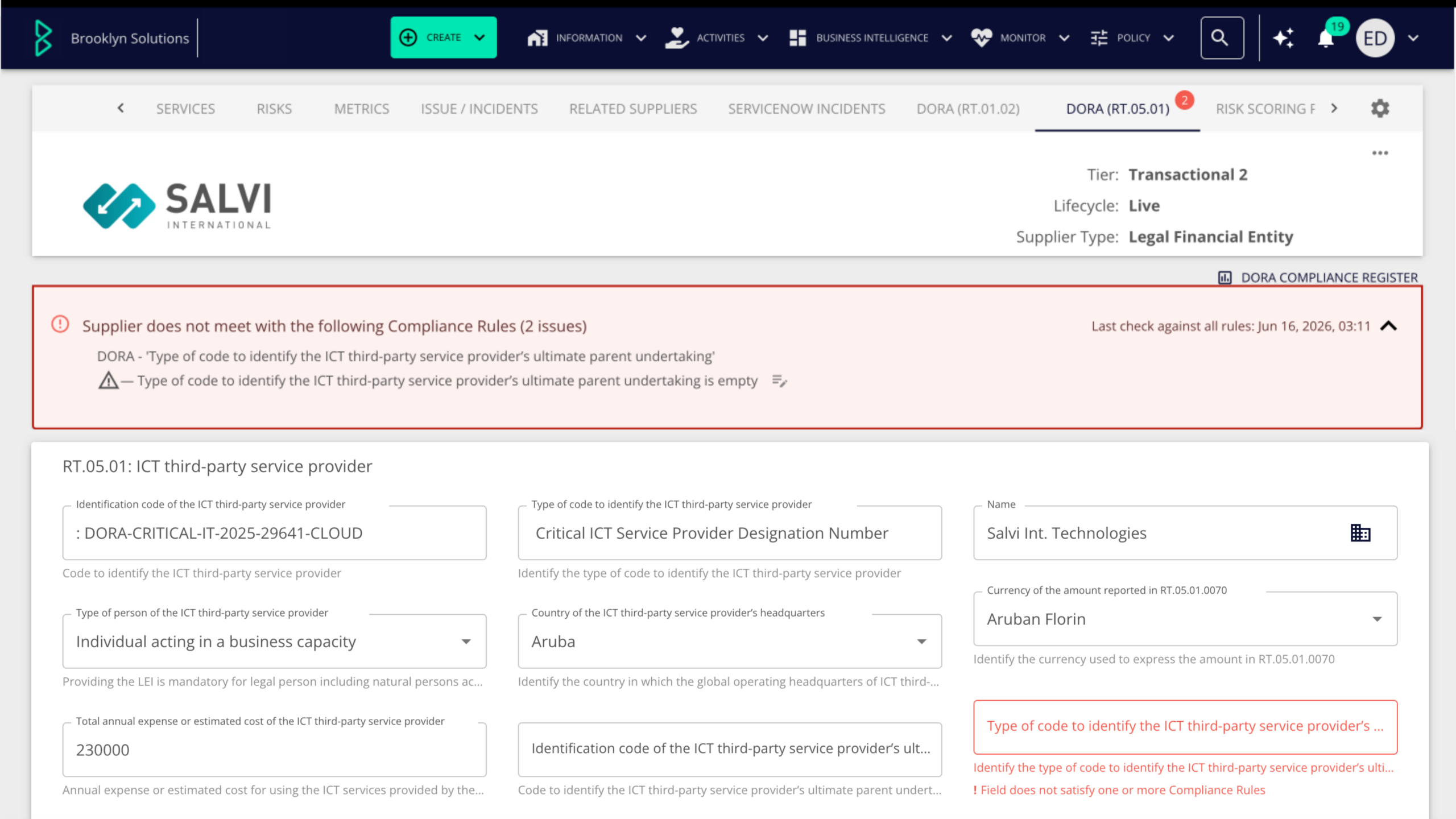
Accurate, consistent data is critical to meeting DORA compliance and regulatory scrutiny. Brooklyn applies intelligent data formatting aligned to DORA regulatory standards, ensuring information is structured, normalised, and audit-ready from the outset. Automated data population reduces manual effort and errors by reusing validated information across risk registers, incident reports, and DORA reporting outputs.
Elite contract Management
Integration with trusted reference data further enhances accuracy and consistency, supporting reliable DORA ICT risk management and third-party ICT risk assessment. This intelligent approach ensures regulatory confidence while enabling faster insights and more effective decision making under the Digital Operational Resilience Act.
Risk Management
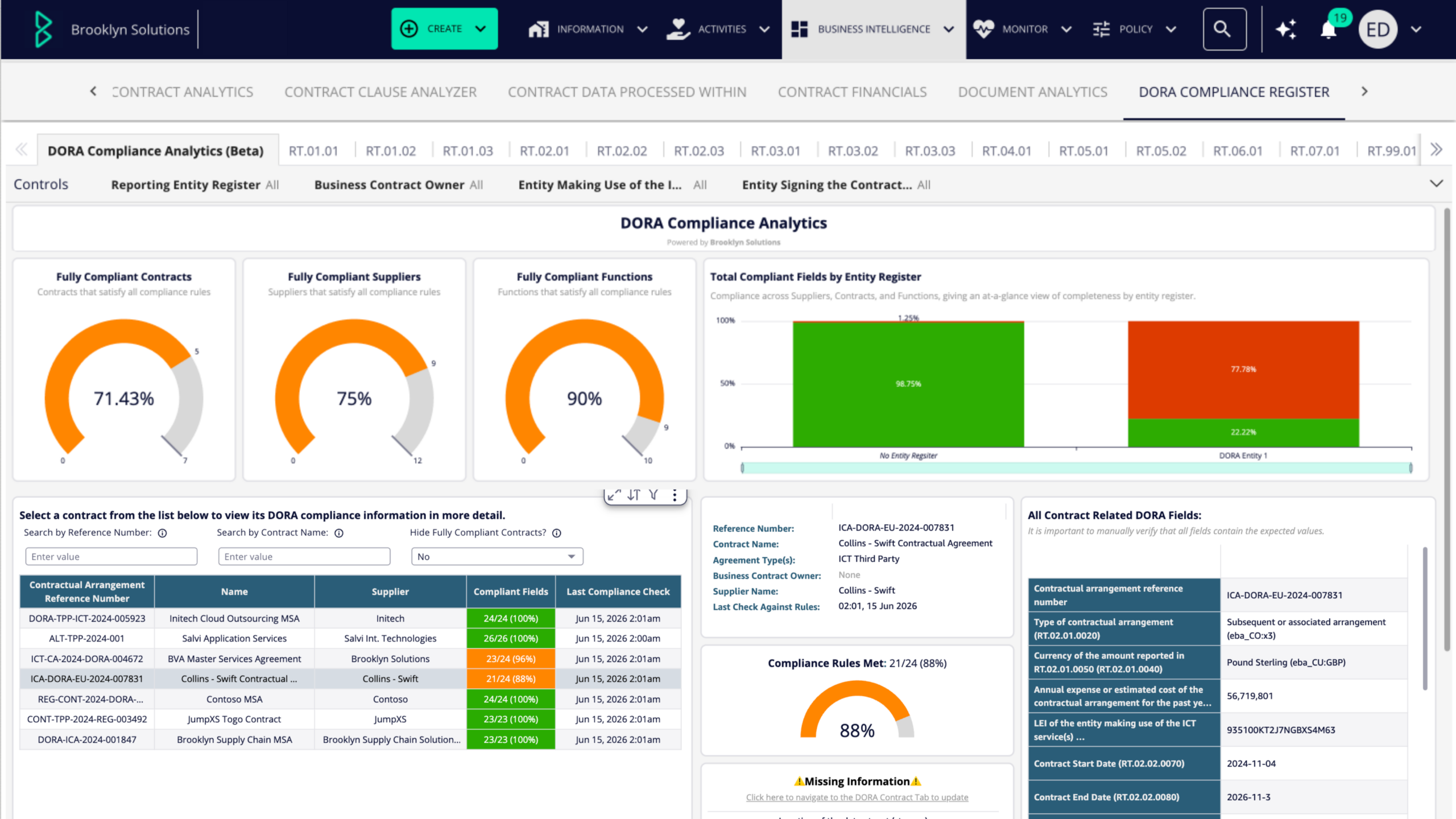
Complete visibility is essential for effective DORA risk management. Brooklyn provides a real-time, high-level view of your ICT third parties, combining risk profiles, active and residual risks, risk ratings, and a full audit trail of incidents, remediation progress, and resolved issues. This centralised oversight supports ongoing ICT third-party risk management and strengthens DORA operational resilience. With regulator-ready evidence available at any time, organisations can confidently demonstrate DORA compliance, meet DORA audit requirements, and respond quickly to supervisory requests under the Digital Operational Resilience Act.
Risk Capture in Real-time
Real-time risk visibility is critical to effective DORA compliance. Brooklyn enables comprehensive risk capture through continuous reviews, surveys, and assessment, ensuring no third-party ICT risk is overlooked. The automated ICT risk register logs risks as they arise, providing real-time tracking of actions, ownership, and remediation progress. Intelligent prompts guide risk owners on required next steps, while dynamic risk scoring aligns mitigation measures with internal risk policies, secure outsourcing practices, and DORA requirements. This proactive approach strengthens DORA operational resilience and supports robust DORA risk management under the Digital Operational Resilience Act.