
Brooklyn solutions logo
  • Products
    • Contract Lifecycle Management
    • Customer-Supplier Relationship Management
    • Third Party Risk Management
    • DORA Regulations
    • Governance, Risk & Compliance (GRC)
    • Brooklyn ESGa+
    • Digital Assessment Frameworks
    • Integrations
  • Use Cases
    • Onboarding & Segmentation
    • Policy, Governance & Workload Orchestration
    • Performance, Scorecards & Reporting
    • SLA & KPI Processing
    • Contract & Obligation Management
    • Innovation, Issues, Change & Dispute Management
    • Structured Reviews & Action Tracking
    • Operational Risk Capture, Mitigation & Controls
    • Third Party Risk Management
    • Meeting Regulatory Compliance
    • Environmental, Social and Governance
    • Contract Assessments
  • Services
    • Services for Success
    • Professional Services
    • Rapid Start Programme
  • Resources
    • News & Insights
    • Resource Library
    • Case Studies
    • Upcoming Events
  • Company
    • About us
    • Partners
    • Meet The Team
    • Careers
Book a Discovery Call
Brooklyn solutions logo
Book a Discovery Call
  • Products
    • Contract Lifecycle Management
    • Customer-Supplier Relationship Management
    • Third Party Risk Management
    • DORA Regulations
    • Governance, Risk & Compliance (GRC)
    • Brooklyn ESGa+
    • Digital Assessment Frameworks
    • Integrations
  • Use Cases
    • Onboarding & Segmentation
    • Policy, Governance & Workload Orchestration
    • Performance, Scorecards & Reporting
    • SLA & KPI Processing
    • Contract & Obligation Management
    • Innovation, Issues, Change & Dispute Management
    • Structured Reviews & Action Tracking
    • Operational Risk Capture, Mitigation & Controls
    • Third Party Risk Management
    • Meeting Regulatory Compliance
    • Environmental, Social and Governance
    • Contract Assessments
  • Services
    • Services for Success
    • Professional Services
    • Rapid Start Programme
  • Resources
    • News & Insights
    • Resource Library
    • Case Studies
    • Upcoming Events
  • Company
    • About us
    • Partners
    • Meet The Team
    • Careers
Solutions

AI Implementation Strategy: Why Process Comes First

June 8, 2026 AI Productivity Strategy Emily Devereux

AI Implementation Strategy: Why Process Comes First

Share this article:
AI Implementation Strategy: Why Process Comes First thumbnail

AI Strategy & Insight  |  Brooklyn Solutions

Before You Chase AI, Understand Your Processes

Nick Francis  ·  Co-Founder & CTO, Brooklyn Solutions  ·  June 2026

Every major technology wave of the last two decades has carried the same hidden requirement — one that most organisations skip, and then wonder why the results disappoint. AI is no different.

I recently came across the comic below on LinkedIn, and it stopped me mid-scroll. A crowd of executives chanting for AI agents, flatly refusing to fix their data first, openly admitting they have no idea what they actually want AI to do — and demanding it all right now. It was funny. It was also uncomfortably accurate.
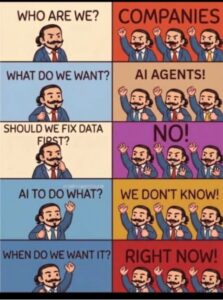
AI Readiness Gap

Comic by @chrissaavedraan via LinkedIn — executives demanding AI agents while admitting they have no clean data and no defined use case.

Sitting with a bit of holiday headspace, it prompted me to reflect on something I’ve watched play out repeatedly across my career: the pattern of organisations chasing the next wave of technology without laying the groundwork that makes that technology actually useful.

We’ve Seen This Before

Think back to 2007 and 2008. Mobile was arriving. Cloud compute was beginning to democratise access to storage and processing power at a scale previously unimaginable outside of large enterprise. Digital transformation — the move from paper-based, analogue processes to digitised, scalable operations — was gathering momentum.

If you look at the arc of technology, from the silicon chip upward through machine code, binary, early programming languages, and into today’s sophisticated development platforms, what you see is commoditisation, layer upon layer. Each new layer makes the one below it more accessible, more powerful, and easier to build on.

What’s happening with AI today is that same phenomenon, compressed and accelerated by everything that preceded it. This isn’t new. Every major technology wave repeats the same pattern. We’re just one layer higher — and that layer is now commoditised enough for almost anyone to reach.

The examples are everywhere. Uber took an analogue, fragmented, geographically inconsistent experience — getting a taxi — and made it globally consistent, digitised, and on-demand. Mobile banking turned what was once a branch visit into a transaction you complete while standing in a queue for coffee.

These weren’t just technology projects. They were process transformations enabled by technology. And they only worked because someone understood the underlying process well enough to redesign it.

The Part Nobody Wants to Do First: Process Mapping Before AI

My background includes Lean Six Sigma training, and one principle has proven true across every technology transformation I’ve been involved in: you cannot improve — let alone automate — what you do not understand.

Before you can adopt AI at any meaningful scale, before you deploy an agent to handle a task, before you even write a prompt that produces consistent results, you need to understand your processes end-to-end. Not in broad strokes. In detail.

Here are the four steps every leader should take before AI implementation begins:

  1. Map your processes completely. Know every step, every decision point, every handoff, every exception path. If you can’t draw it out, you don’t understand it well enough to improve it. Process mapping isn’t admin work — it’s the bedrock of any AI implementation strategy that actually delivers ROI.
  2. Define inputs and outputs at each step. What triggers each task? What does “done” look like? What data goes in, and what comes out? AI agents can only operate within the boundaries you define. Undefined inputs produce undefined outputs.
  3. Define what “good” looks like. For each step and for the process as a whole, establish measurable quality criteria. AI needs to know what success looks like. This is the single step most AI adoption strategies skip — and it’s the one that separates transformative implementations from expensive disappointments. If you don’t know what good output looks like, your AI certainly won’t.
  4. Accumulate good, clean data. AI learns from examples. Without historical data that reflects real outcomes — both good and bad — you have nothing to train on, evaluate against, or improve from. Data readiness is your AI readiness.

Frameworks like Lean Six Sigma exist precisely to help organisations find inefficiencies along the process chain: the steps that don’t add value, the bottlenecks, the steps that are poorly defined and therefore inconsistently executed. These are the exact steps that are either most ripe for AI-assisted improvement, or most dangerous to automate prematurely.

The intersection of Lean Six Sigma discipline and AI capability is where the real transformation happens — but only if you do the foundational work first.

Where AI Fits — and Where It Doesn’t (Yet)

Here’s what I find genuinely exciting about the current moment: for organisations that have done the groundwork, AI can deliver transformative value at the task level within AI business process automation. Not necessarily at the end-to-end process level — not yet, and not without careful governance — but within well-defined, well-understood steps, AI agents can accelerate throughput, reduce error rates, and free human teams to focus on higher-order judgement.

This is why human-in-the-loop architecture matters so much. Regulation — particularly the EU AI Act and the evolving landscape of AI governance globally — is increasingly mandating oversight for AI operating within critical or decision-influencing processes. That’s not an obstacle. It’s the right design principle for this stage of maturity. You need to be able to verify that your AI is performing correctly, that its outputs are traceable, and that a human can intervene when needed.

If you don’t understand your process structure — the individual tasks, the data inputs and outputs, what good looks like — you will never get the best from an AI agent. You haven’t taught it what you need.

At Brooklyn Solutions, this sits at the core of how we’ve designed Ask Brooklyn and our broader agentic AI capabilities. Every AI interaction is logged — prompt, context, response. Every agent operates within defined boundaries. Governance isn’t bolted on afterwards. It’s structural.

A Note on Greenfield vs. Existing Processes

There is one scenario where AI can genuinely help you design a process from scratch — the greenfield case, where there’s no existing way of working to unpick. In that context, AI can be a powerful co-designer. But the moment you have legacy processes, legacy data, and legacy behaviours in play, the burden of understanding falls on you before AI can help you improve anything.

Your AI Readiness Checklist

Before the next board conversation about AI strategy, ask yourself honestly:

✓

Do we have documented, end-to-end process maps for the workflows we want to improve?

✓

Can we define, clearly and precisely, what good output looks like at each stage?

✓

Do we have clean, structured data that reflects how those processes actually perform today?

✓

Have we identified which specific tasks — not whole processes — are candidates for AI augmentation first?

If the answer to most of those is no, the most valuable thing you can do right now isn’t to deploy an AI tool. It’s to start mapping.

Same Wave, Higher Layer

The organisations that extracted the most value from mobile didn’t just build an app — they rethought the underlying service. The companies that benefited most from cloud didn’t just lift-and-shift — they redesigned for scale. Digital transformation that worked wasn’t digitisation for digitisation’s sake — it was process change, enabled by technology.

AI is no different. It is the latest and most powerful layer of commoditisation in a decades-long progression. The barrier to entry is lower than it has ever been. The potential reward is extraordinary. But the prerequisite — understanding what you’re actually doing and why — has never changed.

The good news? That foundational work, done properly, delivers value well before the AI is ever switched on. You’ll find inefficiencies you didn’t know you had, eliminate duplication, and create the conditions for AI to deliver results you can measure — not just demo.

Ready to build the foundations for AI that actually works?

Brooklyn Solutions helps enterprise teams understand, govern, and accelerate their AI adoption — safely, compliantly, and with human oversight built in from day one.

Talk to Our Team →

About the Author

Nick Francis

Nick Francis, Chief Technology and Marketing Officer at Brooklyn Solutions

Nick Francis is a well-established and experienced CxO delivering Digital & Security-focused Transformation through the design, build, and deployment of cost-effective, highly automated industry-leading solutions. Nick has experience working across the private and public sectors in industries such as Financial Services, Insurance, Legal, Utilities, Retail, Public Sector and Government. Specialised in transformation activity to optimise processes, operational expenditure, and increase productivity. Significant experience in compliance, risk & control activities in highly regulated industries, standardisation of technologies, streamlining of internal processes and continuous improvement driving consistency and efficiency across an organisation whilst holding Customer, Colleague and Partner experience at a premium.


Share this article:
Related Articles
AI Implementation Strategy: Why Process Comes First
June 8, 2026
AI Productivity Strategy
Inside the CAB: Our CEO Reflects on the Future of Supplier Management
October 1, 2025
AI Company News Supply Chain

Deal Signed. Time to Deliver.

Book a demo today
Get Started Contact Sales
Get the latest from Brooklyn Solutions in your inbox
A monthly digest of the latest news and insights from Brooklyn Solutions
Brooklyn Solutions logo
Solutions
Customer-Supplier Relationship Management Contract Lifecycle Management Third Party Risk Management Governance, Risk & Compliance (GRC)
Services
Professional Services Services for Success Rapid Start Programme Integrations
Company
About Us Partners Team ESG Rating
© Brooklyn Solutions Privacy Policy
Designed & Built by Creo