Trusted by regulated enterprises

Why Traditional CLM Tools Fail the Enterprise
Most CLM software is built for Legal (drafting), not Business (managing). Legal teams get a drafting workflow; procurement, vendor management, and compliance teams get a digital filing cabinet. Here is where that leaves you exposed.
The repository trap
Contracts live as unsearchable PDFs in a folder structure. When someone needs to know whether a supplier’s SLA allows a specific penalty, the answer is “someone check the contract”, not “Ask Brooklyn”. The knowledge exists, but it isn’t reachable when the decision has to be made.
No active monitoring
Traditional CLM tools wait to be searched. They don’t alert you when an obligation deadline approaches, when a supplier’s performance dips below threshold, or when a regulatory change affects your agreement terms. An auto-renewal you meant to renegotiate passes silently. A missed obligation only surfaces once it has already cost you.
The integration gap
A signed contract contains promises about pricing, service levels, and delivery timelines, but most CLM platforms never connect those promises to what actually happens in your ERP, P2P, or CRM. The contract says one thing, the invoice says another, and nobody notices until the audit. When the regulator asks you to evidence control of your agreements, “we think it’s in the contract” is not an answer.
Brooklyn closes that gap by making contracts active, not archival.
The Agentic Advantage
Our platform utilises RAG 2.0 (Retrieval-Augmented Generation) architecture to move beyond simple keyword searches. By employing Agentic Reasoning, the system doesn’t just find a clause; it understands the commercial context and legal intent behind it.
-
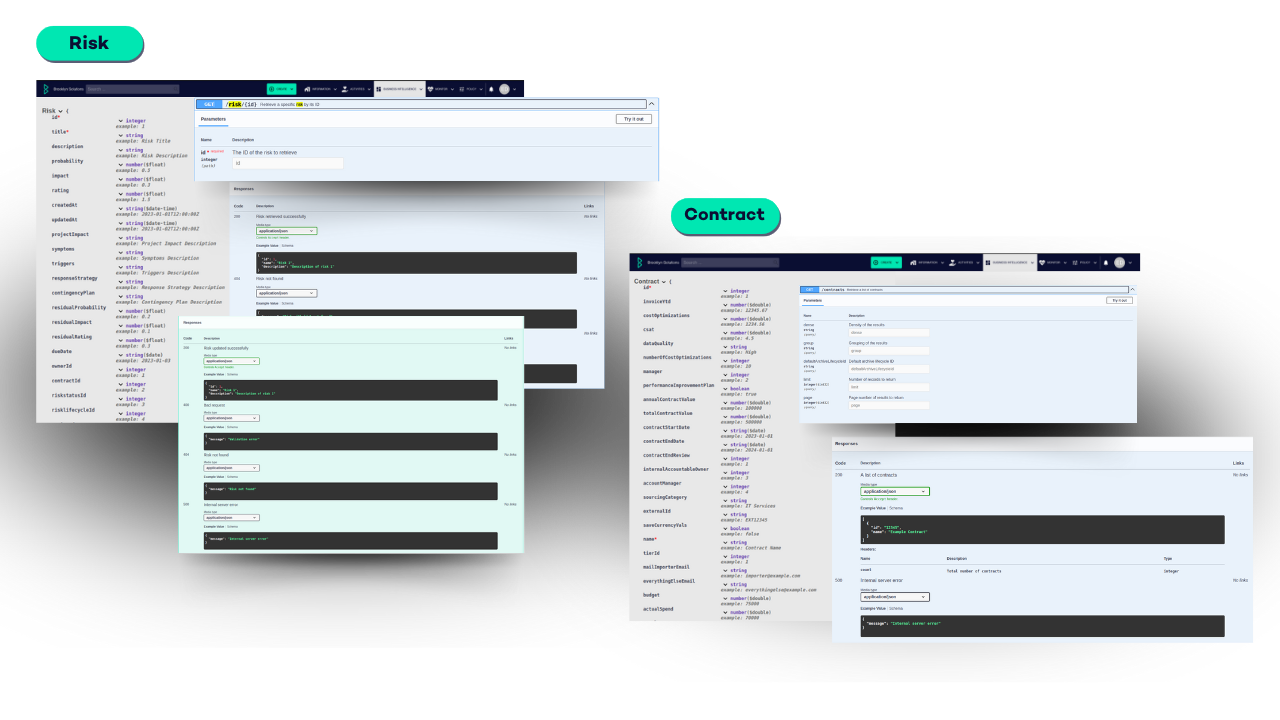
Autonomous Metadata Extraction: Using Named Entity Recognition (NER), our agents ingest multi-format contracts (PDF, Word, Email) to instantly structure data around counterparty risks, liability caps, and renewal triggers.
-
Self-Governing Compliance: Our AI agents are pre-mapped to global regulatory frameworks, including DORA, ESG (CSRD), and the EU AI Act. The system proactively flags “Above Playbook” deviations before they become audit liabilities.
-
Interoperable Intelligence: Through the Model Context Protocol (MCP), Brooklyn’s agents bridge the gap between your legal language and your operational reality, autonomously triggering workflows in your ERP and CRM systems to remediate contract leaks in real-time.
Contract Intelligence
- Contract clause analysis: identify and analyse specific clauses across thousands of documents, pinpointing how clauses interact or overlap and flagging conflicts before they become problems.
- Contract summarisation & conformance: multi-document contracts distilled into clear overviews highlighting essential terms, responsibilities, and commercial points.
- Document comparison & version control: compare contract versions in seconds; additions, removals, and modifications between drafts are flagged, so redline review that took hours now takes moments.
- Contract search topic guidance: explains why specific sections matter and suggests relevant search terms to improve accuracy.
- AI-powered field suggestions: data field values suggested directly from contract content, for faster entry and fewer manual errors.

Meeting & Communication Intelligence
- Automated meeting summaries: key points captured from meeting data, presented as concise summaries ready to share with stakeholders.
- Meeting enhancement tools: preparation materials such as agendas, topic outlines, and recommended actions, generated from historical contract and relationship data.

Risk & Insights
- Risk management assistant: identifies, creates, and tracks risks across supplier and customer engagements, proposing mitigations and future actions based on contract terms and historical patterns.
- Data analysis & insights: contextual queries for vendor performance, risk profiling, and contract evaluation. Ask “which suppliers are at risk of missing Q3 obligations?” and get an answer drawn from your actual contract data.
- Natural language platform control: search for suppliers, create and update contracts, log risks, and initiate processes through a conversational chat experience, with no traditional UI navigation required.

Post-Signature
Up to 30% of contract value is lost post-signature due to disjointed repositories and unmonitored obligations. Traditional CLM tools were built for legal drafting, not business management, they store contracts; they don’t police performance. Brooklyn operates in the space after the signature, the “Performance Lifecycle”, where commercial value is actually won or lost.
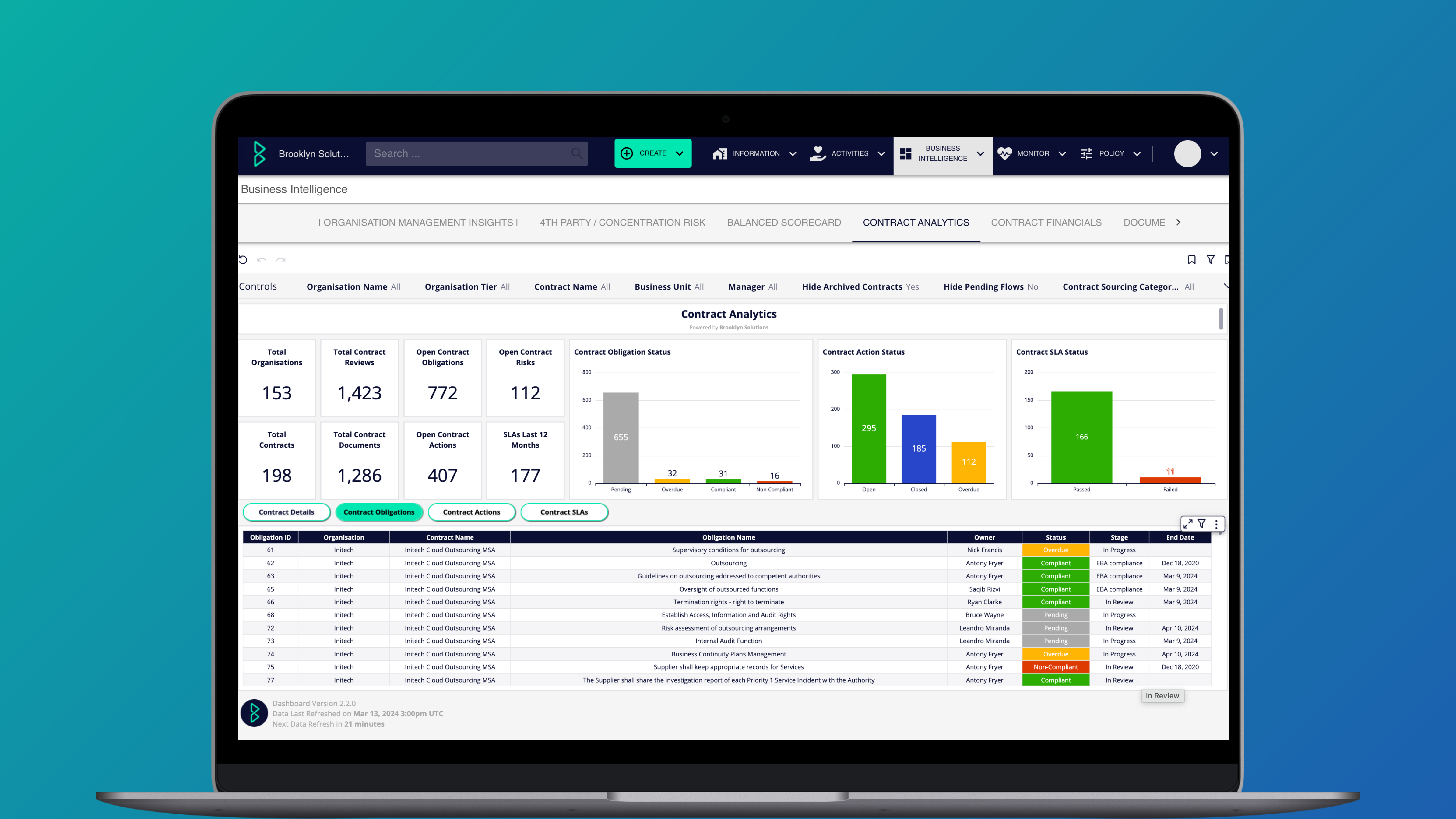
- Obligation tracking: autonomous extraction of contractual obligations with automated monitoring against delivery; deadlines, SLAs, and compliance requirements surfaced before they’re missed.
- Regulatory compliance: contracts mapped to frameworks including DORA, the EU AI Act, EBA Outsourcing Regulations, and PRA requirements, with continuous monitoring and audit-ready evidence trails.
- Variation & amendment management: governed workflows for contract changes, with full version history and impact analysis on linked obligations.
- Renewal intelligence: proactive alerts with commercial context: not just “this contract expires in 90 days”, but “this contract expires in 90 days, the supplier’s performance score has dropped 12%, and the market rate has shifted 8%. Do you want to negotiate?”
- Audit reporting: digitally fit-for-audit by design: every contract action logged, every obligation tracked, every decision traceable.

Integrations
Brooklyn is built to complement your existing stack, not replace it. It fills the gap between signature and operational delivery that traditional CLM tools leave open, connecting contractual promises to what actually happens in your operational systems.
- Operational systems. Brooklyn connects to ERP, CRM, and P2P platforms, so the pricing, service levels, and delivery timelines in a contract can be checked against what is invoiced and delivered.
- Open connectivity. Integration is via standard APIs and the Model Context Protocol (MCP), giving Ask Brooklyn interoperable access across your systems rather than a single closed platform.
- Works alongside your CLM and procurement tools. Brooklyn complements existing CLM and source-to-contract tooling, adding post-signature intelligence on top of the systems your teams already use.

Built for the Concerns That Stop Most Rollouts
- “We can’t rip and replace our stack.” You don’t. Brooklyn complements your existing CLM, ERP, and procurement tools through APIs and the Model Context Protocol, adding post-signature intelligence on top of what you already run.
- “Our contract data is sensitive.” Brooklyn runs on AWS with SOC 2 and ISO 27001 certification, processes data within the EU, and applies human-in-the-loop guardrails with full audit logging on every AI action.
- “AI answers can’t be trusted in a regulated setting.” Ask Brooklyn uses RAG 2.0 to ground every answer in your actual contract data, with source-linked responses, not a probabilistic guess.
- “We have years of legacy contracts.” Brooklyn bulk-ingests legacy PDFs, scanned documents, and emails via OCR, extracting clauses, parties, dates, and obligations so your existing estate becomes queryable.

Post Signature Management
This is where contract value is won or lost. Once signed, risks change: they become operational, triggering compliance requirements and renewal timelines. Brooklyn’s platform was designed for this phase.
- Obligation tracking. Every contractual obligation, milestone, and SLA is extracted, structured, and monitored. Brooklyn alerts your team before deadlines pass, not after.
- SLA performance monitoring. Track supplier performance against contracted service levels in real time. When a supplier dips below threshold, Brooklyn flags it, with the relevant contract clause linked.
- Amendment management. Contract variations are reviewed through defined, auditable workflows. Every change is tracked, versioned, and linked to the original agreement.
- Renewal intelligence. Brooklyn evaluates renewal decisions using performance scores, market rates, and supplier history, so you’re not auto-renewing contracts you should be renegotiating.
- Audit reporting. Every decision, every change, and every query is logged and traceable. Regulators ask for evidence; Brooklyn provides it, structured, timestamped, and linked to the source contract.
How CLM Software Improves Control and Visibility
The primary value of CLM software lies in its ability to make contracts visible and manageable over time. By structuring contract data and applying workflow controls, CLM software reduces reliance on manual intervention and informal tracking.
Obligations can be monitored proactively rather than reactively. Amendments can be reviewed and approved through defined processes. Renewals can be evaluated with sufficient notice and context. Collectively, these capabilities reduce risk and improve decision-making.
Importantly, CLM software also provides an auditable record of activity, which is increasingly important in regulated industries and during internal or external reviews.